How to Automate Microsegmentation Policies with CI/CD: RSAC 2026 Recap
RSAC 2026 has wrapped, and the dominant theme in the network security track was unmistakable: automation. Multiple sessions, keynotes, and vendor demos focused on treating microsegmentation policies as code — managing them through CI/CD pipelines rather than firewall ticket queues.
The Automation Imperative
If you are still managing microsegmentation policies through a firewall ticket queue, you are doing it the hard way. Modern zero trust security demands that network policies move as fast as the workloads they protect — and that means treating policies exactly like application code.
Policy-as-code was the practice that generated the most attendee interest at RSAC this year. The concept is straightforward: define, validate, and deploy microsegmentation rules through the same CI/CD pipeline that ships your software. When done right, it eliminates the bottleneck between “we need a rule change” and “the change is live.”
What RSAC Revealed
Several key takeaways from the conference sessions:
GitOps for security policies is production-ready. Multiple vendors demonstrated policy management through git repositories — pull requests trigger automated validation, staging deployment, and production rollout. A change that used to take three days now takes thirty minutes.
Validation tooling has matured. Open Policy Agent (OPA) and Conftest were referenced in nearly every session. Teams are writing Rego rules that encode security standards — “production databases must only accept traffic from the app tier” — and the pipeline rejects any policy that violates those standards.
The OPA-conftest pipeline is the reference architecture. Schema validation, syntax linting, conflict detection, and dry-run enforcement are all achievable with open-source tooling. The commercial value comes from integration with existing enforcement platforms and SIEM tools.
The Five-Stage Pipeline
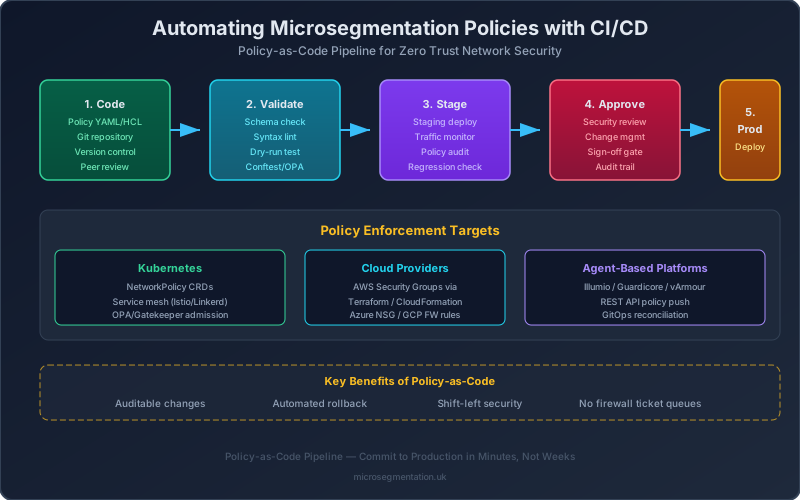
The RSAC sessions converged on a five-stage pipeline for microsegmentation policy management:
- Policy Storage — YAML, HCL, or JSON files in a git repository with versioning and GPG signing
- Validation and Linting — schema validation, conflict detection, OPA policy checks
- Staging Deployment — push to a non-production environment with monitoring
- Approval Gates — security team reviews the diff and signs off
- Production Rollout — deploy with canary percentages and rollback capability
Practical Advice from the Floor
The practitioners who presented at RSAC shared consistent advice:
- Start with one Kubernetes namespace or one cloud VPC, prove the pipeline works, then expand
- Never allow out-of-band policy changes — enforce through infrastructure-as-code with drift reconciliation
- Track time-to-deploy, change failure rate, and policy drift incidents as your key metrics
For web application security policies specifically, consider integrating with a WAAP solution at the staging stage. waap-security.uk provides a CI/CD-ready API for policy management that complements network-level segmentation. For AI-driven traffic analysis that can detect anomalous lateral movement, aisecurities.uk provides continuous monitoring that enhances your segmentation controls.
The Bottom Line
RSAC 2026 made it clear: automation is not an advanced practice for microsegmentation — it is the only way to operate at scale. If you have more than a handful of workloads and you are still managing rules by hand, you have already fallen behind. Start with one environment, prove the pipeline, and expand from there.
Want to go deeper? Check out these resources on Amazon:
As an Amazon Associate I earn from qualifying purchases.