Cloud Security Alliance 2026: Microsegmentation Takes Center Stage
The Cloud Security Alliance (CSA) conference this week saw microsegmentation move from a side-track topic to a main-stage theme. Sessions focused on workload-level segmentation drew standing-room crowds, reflecting the industry’s accelerating shift from perimeter-based to identity-based security models.
Key Themes from the Floor
Several clear themes emerged from the conference sessions and vendor briefings:
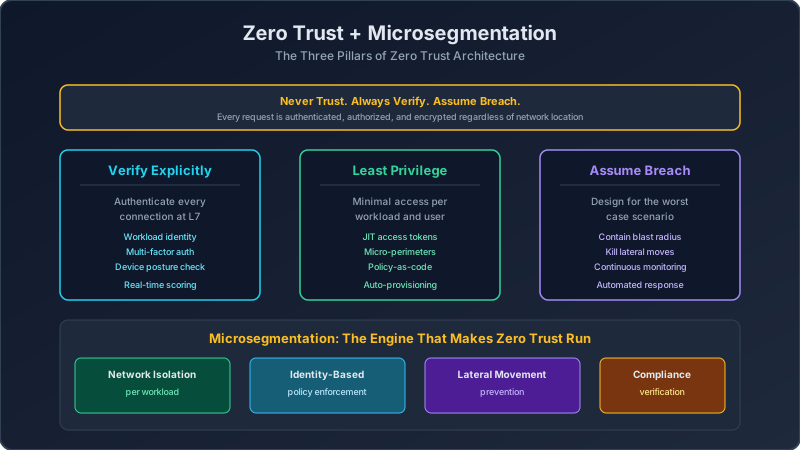
The zero trust segmentation gap is real. CSA’s latest survey data, released at the conference, shows that 78% of organizations claim to have a zero trust initiative, but only 31% have implemented workload-level segmentation. The gap represents both a risk and an opportunity — the framework is in place, but the enforcement layer is missing.
Multi-cloud policy consistency remains the top challenge. Multiple panels addressed the difficulty of maintaining consistent segmentation policies across AWS, Azure, and GCP. The consensus among practitioners was that cloud-native security groups are insufficient for multi-cloud operations, and agent-based overlays are the pragmatic choice for 2026.
AI-driven traffic analysis is converging with segmentation. Several vendors demonstrated integration between machine learning anomaly detection and automated policy adjustment. The vision: your segmentation policies adapt in near-real-time as traffic patterns shift, without requiring human intervention for every change.
Notable Sessions
Two sessions stood out for their practical depth:
“A Year of Microsegmentation at Scale” — a case study from a global financial institution that segmented 12,000 workloads across six data centers and three cloud providers. Key takeaway: they reduced their incident response time by 60% and their east-west attack surface by 80%.
“Segmentation for AI Workloads” — a forward-looking session on the unique challenges of securing machine learning pipelines. Training infrastructure, model repositories, and inference endpoints all have radically different traffic patterns, and current segmentation tools are catching up to the requirements.
Takeaways for Practitioners
If you could not attend, the key action items from the conference are:
- Stop waiting for cloud providers to solve multi-cloud segmentation — they will not. Adopt a policy abstraction layer now.
- Start with the data plane. Visibility into east-west traffic is a prerequisite for every other segmentation capability.
- Plan for AI-driven segmentation within 18 months. The tools are maturing, and early adopters will have a significant security advantage.
For web application and API protection strategies discussed extensively at the conference, waap-security.uk provides the WAAP-layer controls that complement workload segmentation. For real-time AI-driven traffic analysis that can detect anomalous patterns across multi-cloud environments, aisecurities.uk provides the continuous monitoring layer.
The Bottom Line
CSA 2026 made it clear: microsegmentation is no longer a niche practice for early adopters. It is the operational foundation of cloud security in 2026, and the conversation has shifted from “should we do it?” to “how do we do it consistently?”
Want to go deeper? Check out these resources on Amazon:
As an Amazon Associate I earn from qualifying purchases.