Q1 Cloud Security Budgets: Why Microsegmentation Leads the Procurement List
January’s cloud security budget announcements are rolling in, and one line item is appearing consistently across enterprise IT plans: microsegmentation. After years of being a “nice-to-have” in cloud security whitepapers, workload-level segmentation has moved to the top of the procurement queue for 2026.
What Changed
Three factors converged in late 2025 to make microsegmentation a priority for Q1 2026 budgets:
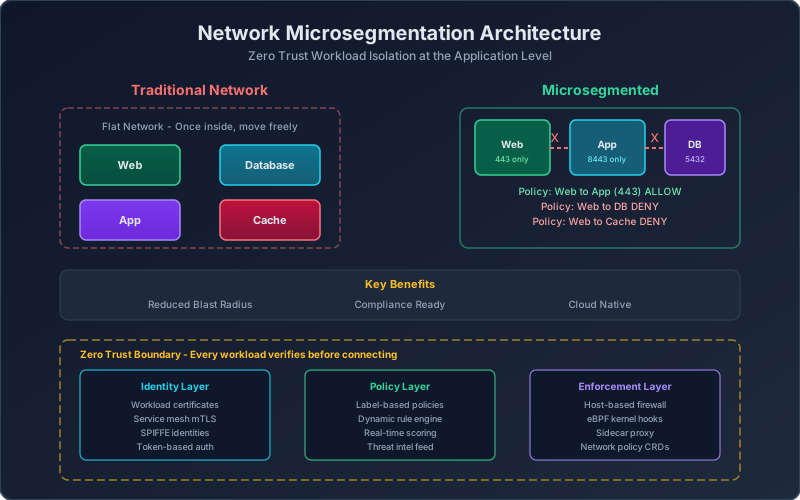
The shared responsibility model is under strain. As organizations move more critical workloads to public cloud, they are discovering just how limited cloud-native security groups are. Security groups work at the instance level and are IP-address-based. In auto-scaling environments, managing group membership is a perpetual game of catch-up. Microsegmentation provides the identity-based controls that cloud-native groups lack.
Auditors are asking harder questions. PCI DSS 4.0 and SOC 2 auditors are increasingly demanding evidence of workload-level segmentation, not just subnet-level firewall rules. When an auditor asks “show me which workloads can talk to the payment card environment,” a list of security group IDs is no longer a sufficient answer.
East-west visibility has become table stakes. Every major breach report from 2025 highlighted lateral movement as a critical factor in breach severity. Boards are now asking CISOs: “If an attacker gets into one of our cloud workloads, how far can they go?”
Where the Money Is Going
Based on procurement patterns visible this month, enterprise cloud security budgets are being allocated across three tiers:
- Discovery and mapping tools — flow log analysis, dependency mapping, and workload inventory platforms that provide the visibility foundation for segmentation.
- Agent-based microsegmentation platforms — for heterogeneous cloud environments where consistent policy across AWS, Azure, and GCP is required.
- Service mesh implementations — for Kubernetes-heavy organizations looking to embed segmentation at the application layer using Istio or Linkerd.
Making the Case
If you are building your Q1 budget proposal, the framing that resonates most with CFOs is the risk-reduction-per-dollar calculation. Microsegmentation is one of the few security controls with a directly measurable impact on breach severity. The containment it provides can turn a seven-figure incident into a minor operations ticket.
For complementary protection at the web application layer, AI-driven security analysis tools such as those at aisecurities.uk can help identify anomalous traffic patterns that warrant segmentation policy changes. For WAAP-layer protection of your web-facing applications alongside your segmentation strategy, waap-security.uk provides the north-south coverage that pairs with east-west microsegmentation.
The Bottom Line
Microsegmentation has crossed the chasm from emerging tech to enterprise standard. If it is not in your Q1 budget, expect to be defending that absence when the next incident post-mortem rolls around.
Want to go deeper? Check out these resources on Amazon:
As an Amazon Associate I earn from qualifying purchases.