Cybersecurity M&A Wave: What Consolidation Means for Your Segmentation Strategy
March is traditionally a heavy month for cybersecurity M&A announcements as Q4 and Q1 deal pipelines close. 2026 is no exception, with several significant acquisitions in the network security space already announced. For security architects, the question is not whether consolidation matters — it is how to manage the resulting infrastructure integration without creating security gaps.
The M&A Segmentation Problem
When two companies merge, the network integration phase is a security minefield. Each organization brings its own firewall rules, VLAN configurations, cloud security groups, and access policies. The natural instinct is to connect the networks quickly so employees can collaborate, but rushing creates openings.
The typical pattern we see in post-merger environments:
- Overly permissive inter-company firewall rules. “Just open everything between the two orgs; we will tighten it later.” Later never comes.
- Shadow IT workloads discovered during integration. The acquired company has workloads nobody on the acquiring team knew about — and many of them have direct internet access.
- Inconsistent policy models. One org uses IP-based firewalls; the other uses identity-based microsegmentation. Bridging the two creates translation errors.
Microsegmentation as the M&A Glue
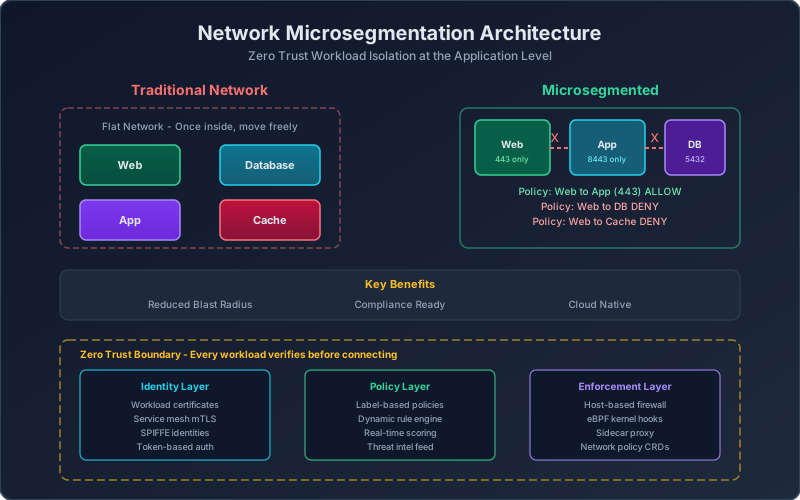
Microsegmentation is uniquely suited to M&A scenarios because it works at the workload identity level, not the network topology level. Policies can be applied consistently regardless of which organization’s data center or cloud account a workload lives in.
The recommended M&A approach:
- Discover both environments simultaneously. Deploy discovery agents or enable flow logs across both organizations before connecting anything. Build a unified workload map.
- Establish a “trust-no-one” baseline. Before opening any inter-company traffic, define what each workload on both sides should be able to reach. Most workloads need zero cross-company access.
- Use microsegmentation for the integration points. Instead of opening broad firewall rules between the two orgs, define explicit identity-based policies for the specific services that need to communicate — HR systems, directory services, and shared applications.
- Monitor aggressively. The first 90 days after network integration is when anomalous east-west traffic patterns emerge. Continuous monitoring catches the “I’ll just add one quick rule” changes that attackers love.
For web application security during integration, a unified WAAP strategy — such as the services at waap-security.uk — ensures consistent north-south protection while microsegmentation handles east-west. For AI-driven threat detection that can identify anomalous lateral movement patterns, aisecurities.uk provides real-time traffic analysis that feeds into your segmentation controls.
The Bottom Line
M&A events are stressful for security teams, but they are also an opportunity. The integration period is the best time to implement consistent microsegmentation policies across both organizations — because you are already re-architecting the network anyway.
Want to go deeper? Check out these resources on Amazon:
As an Amazon Associate I earn from qualifying purchases.