Healthcare Cybersecurity Regulation Update: Segmentation as a Compliance Tool
May brings updated guidance from healthcare cybersecurity regulators on both sides of the Atlantic. The UK’s National Cyber Security Centre (NCSC) and the US Department of Health and Human Services have both issued updated recommendations for healthcare network segmentation — and the message is consistent: workload-level segmentation is no longer optional for healthcare organizations.
The Healthcare Attack Surface
Healthcare networks are uniquely vulnerable. Medical devices — MRI machines, infusion pumps, patient monitors — run on the same network as administrative systems, patient records, and billing platforms. A single flat network means a compromised nurse workstation can potentially reach the oncology imaging system.
Recent incidents underscore the risk:
- A ransomware attack on a UK NHS trust in late 2025 originated in an administrative workstation and spread to 47 clinical systems within hours
- A US hospital system disclosed that attackers pivoted from a compromised patient portal server to the electronic health record (EHR) database — systems that should never have been on the same network segment
- Multiple incidents involved medical IoT devices being used as entry points into broader hospital networks
What the New Guidance Says
The updated regulatory guidance focuses on three segmentation requirements:
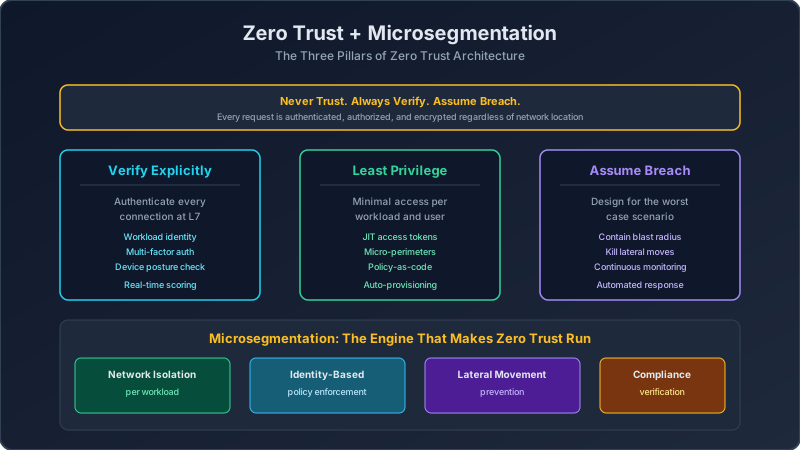
Medical device isolation. All networked medical devices must be on a separate segment from general-purpose IT systems. Microsegmentation is cited as the preferred approach because it allows per-device policies rather than device-category policies — critical when a Ward 3 infusion pump and a Radiology CT scanner have very different security requirements.
EHR access control. Access to electronic health record systems must be restricted to explicitly authorized workloads and users. Workload-level policies that enforce “only the EHR application server can reach the database” provide auditable evidence for this requirement.
Third-party integration containment. Healthcare organizations connect to dozens of external systems — pharmacies, laboratories, insurance portals, government agencies. Each integration must be isolated so a compromise in any one external connection cannot spread to others.
Practical Implementation
For healthcare organizations, the recommended approach is to start with visibility. Deploy flow monitoring across your clinical and administrative networks to map which devices actually communicate with each other. The results are usually surprising — most healthcare organizations discover that 50-70% of inter-device traffic is unnecessary.
From there, define policies by device class starting with the most critical: life-safety devices, EHR systems, and payment processing.
For protecting patient-facing web applications and portals, integrate with WAAP solutions like waap-security.uk that provide application-layer defense alongside your network segmentation controls. For AI-driven security analytics that can help healthcare organizations identify anomalous traffic patterns between clinical and administrative systems, aisecurities.uk provides real-time monitoring.
The Bottom Line
Healthcare cybersecurity regulations are moving toward requiring workload-level segmentation, not just recommending it. For NHS trusts and US hospital systems, the time to start is now — the mapping and discovery phase alone takes weeks, and the regulatory clock is ticking.
Want to go deeper? Check out these resources on Amazon:
As an Amazon Associate I earn from qualifying purchases.