Kubernetes Security in 2026: Why Network Policies Aren't Enough Anymore
Kubernetes security trends for 2026 are converging on a single point: native NetworkPolicy resources are necessary but not sufficient. As clusters grow past a few hundred pods, the limitations of Kubernetes-native segmentation become a real operational burden, and organizations are layering in workload-level microsegmentation to fill the gaps.
The NetworkPolicy Gap
Kubernetes NetworkPolicy is a powerful primitive. It provides L3/L4 access control between pods using label selectors and namespace isolation. But in practice, teams running large clusters hit three walls:
No deny-by-default at the cluster level. NetworkPolicy is additive — if no policy applies to a pod, all traffic is allowed. In a cluster with dozens of namespaces and hundreds of deployments, ensuring every single pod is covered by at least one policy is an audit nightmare. One forgotten deployment means an open door.
No workload identity across clusters. NetworkPolicy is namespace-scoped. It cannot enforce policies across multiple clusters, let alone between clusters and non-Kubernetes workloads. For organizations running hybrid deployments where some workloads are in Kubernetes and others are on VMs or bare metal, this creates a blind spot precisely where attackers love to pivot.
Ephemeral workload challenges. Pods come and go in seconds during rolling updates or auto-scaling events. NetworkPolicy rules apply at the pod IP level, which means the policy surface is constantly shifting. Service meshes solve this with sidecar proxies and mTLS identity, but service mesh adoption is still not universal.
What 2026 Looks Like
The organizations we see making real progress in Kubernetes security are combining three layers:
- Baseline NetworkPolicies for every namespace — deny-all as the default, explicit allow rules for known services.
- Service mesh (Istio or Linkerd) for L7 policies, mTLS, and observability in critical service-to-service paths.
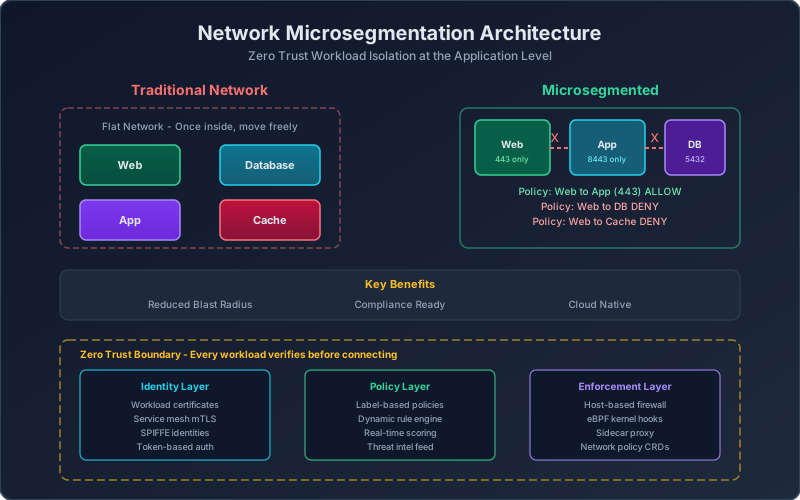
- Workload-level microsegmentation extending beyond Kubernetes into VMs and cloud services, providing a unified policy plane.
This three-tier approach ensures that even if a pod is accidentally misconfigured or a sidecar fails, the workload-level segmentation layer catches the traffic that should not be flowing.
Getting Started This Month
Start small. Pick one production namespace and implement the three-tier approach there. Run it for two weeks with monitoring-only mode, then review the blocked traffic patterns. Most teams discover unexpected cross-namespace dependencies they never documented.
For complementary API security analysis across your Kubernetes ingress, explore the capabilities at waap-security.uk. For AI-driven traffic analysis that can detect anomalous pod-to-pod communication patterns, aisecurities.uk provides the monitoring intelligence that informs your segmentation policies.
The Bottom Line
Kubernetes NetworkPolicy is a great start, but in 2026’s production environments, it needs to be part of a broader segmentation strategy that covers the full attack surface — including everything outside the cluster.
Want to go deeper? Check out these resources on Amazon:
As an Amazon Associate I earn from qualifying purchases.