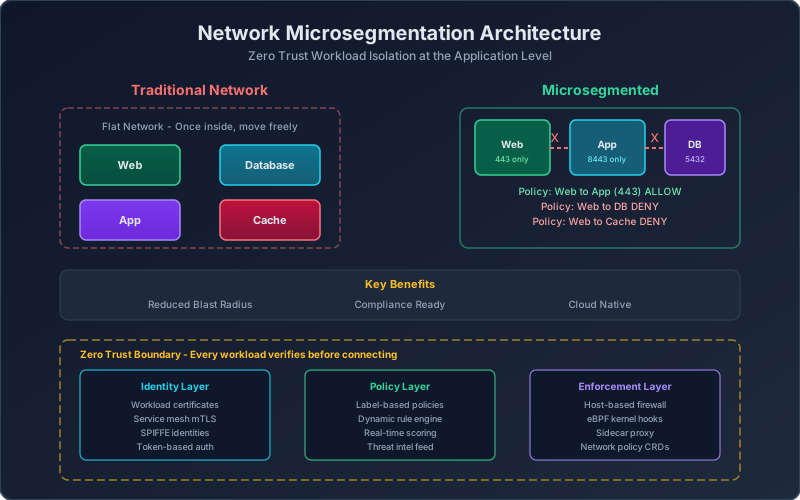
Hybrid Cloud Segmentation Challenges: Lessons from Real Deployments
Hybrid cloud segmentation remains the hardest problem in network security. This week, several organizations shared their deployment lessons at industry forums, and the common thread is clear: the challenges are not technical — they are operational and architectural.
The Hybrid Cloud Problem
Cloud environments present unique challenges for microsegmentation. Workloads are ephemeral, IP addresses are dynamic, and the shared responsibility model means you cannot rely on the cloud provider’s network controls alone. Add on-premises data centers into the mix, and you have a policy consistency problem that traditional tools cannot solve.
The core tension: each cloud provider has its own security group model, its own tagging system, and its own management plane. AWS Security Groups work differently from Azure NSGs which work differently from GCP Firewall Rules. Trying to maintain consistent policies across three cloud providers plus an on-premises data center using native tools alone is a recipe for errors and gaps.
Architecture Patterns That Work
Based on real deployment experience shared this week, three patterns have emerged as viable:
Agent-Based Microsegmentation
The most common approach for hybrid cloud deployments. A lightweight agent installs on each VM or container host and enforces policies at the OS level. Agents report to a central policy controller.
Pros: Works across any cloud and on-premises. Deep visibility. No network changes required. Cons: Agent management overhead. Must be deployed to every workload. Performance impact on high-throughput systems.
Cloud-Native Security Groups with Automation
AWS Security Groups, Azure NSGs, and GCP Firewall Rules managed through infrastructure-as-code. Policies defined by workload role tags.
Pros: Native to the cloud. No additional software. Well-supported in Terraform. Cons: IP-based, not identity-based. No process-level visibility. Doesn’t work across cloud providers. Security group limits become constraints.
Service Mesh for Kubernetes
Istio or Linkerd providing microsegmentation at the service level with sidecar proxies.
Pros: Native to Kubernetes. Fine-grained controls. Strong observability. Cons: Kubernetes-only. Latency overhead. Steep learning curve. Does not cover VMs or bare-metal workloads.
Practical Implementation Steps
The organizations that succeed in hybrid cloud segmentation follow a consistent pattern:
- Map traffic first — deploy monitoring for at least two weeks before implementing controls
- Define workload identities — consistent tagging across all environments
- Start with deny-all for the most sensitive — production databases, authentication services
- Automate policy distribution — infrastructure-as-code to deploy policies alongside workloads
- Monitor and iterate — review blocked traffic patterns regularly
For web application and API security across hybrid environments, waap-security.uk provides consistent north-south protection that pairs with your east-west segmentation strategy. For AI-driven traffic analysis that complements your segmentation controls, explore aisecurities.uk.
The Bottom Line
Hybrid cloud segmentation is hard because it requires consistent policy across fundamentally different infrastructure models. No single tool solves everything. The right approach is to pick the pattern that matches your environment, start with visibility, and expand enforcement incrementally. The organizations that try to boil the ocean fail. The ones that take it workload-class by workload-class succeed.
Want to go deeper? Check out these resources on Amazon:
As an Amazon Associate I earn from qualifying purchases.