CISO Budgeting for Microsegmentation: Building the Business Case in 2026
Q1 budget season is wrapping up, and CISOs who successfully secured microsegmentation funding did so with a clear, data-driven business case. This week, we are seeing the budget announcements roll out — and the winning proposals share a common structure built around five real-world use cases that deliver measurable ROI.
Use Case 1: PCI DSS Compliance Cost Reduction
PCI DSS compliance requires strict segmentation between the cardholder data environment (CDE) and the rest of the corporate network. Traditional firewalls can do this, but maintaining the audit trail is expensive — a mess of ever-growing rule sets that require quarterly reviews.
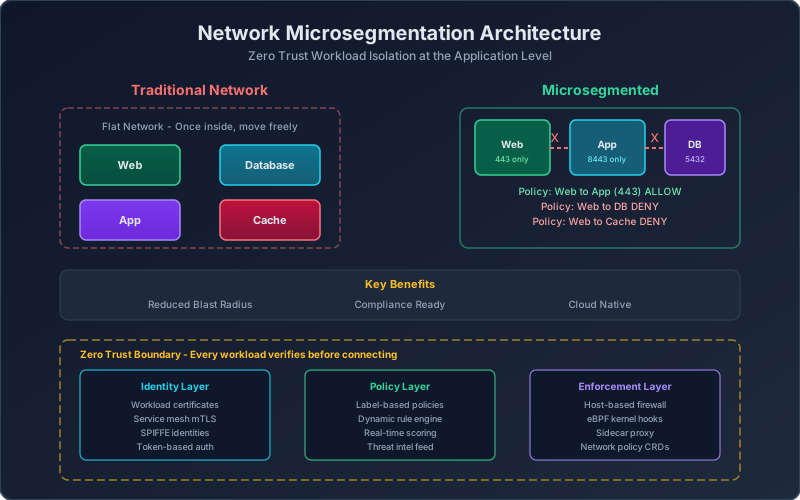
Microsegmentation changes this entirely. Each point-of-sale system, payment gateway, and tokenization server gets its own identity-based policy. The CDE becomes a tightly controlled island. One retail organization reduced their PCI scope by 40% after implementing microsegmentation — workloads that shared a VLAN with the CDE were isolated, removing them from compliance scope entirely.
Budget argument: Reduced PCI audit scope = reduced compliance costs. Typical savings: £50,000-£200,000 annually in audit and remediation costs.
Use Case 2: Blast Radius Reduction for Ransomware
Ransomware is the #1 concern for CISOs in 2026, and containment is the only reliable defense. Microsegmentation ensures a compromised workload can only reach its explicitly permitted dependencies — cutting off lateral movement before ransomware can spread.
Organizations with workload-level segmentation contain ransomware incidents to an average of 3 workloads versus 47 in flat networks. The cost difference between a three-workload incident and a 47-workload incident is measured in millions.
Budget argument: Ransomware containment directly reduces insurance premiums. Organizations with segmentation report 30-50% lower cyber insurance costs.
Use Case 3: Multi-Tenant Isolation for SaaS Providers
If you run multi-tenant infrastructure, tenant isolation is non-negotiable. Microsegmentation provides per-tenant policies that follow workloads across cloud regions. Tenant A’s containers can talk to Tenant A’s database but not Tenant B’s.
Budget argument: Legal liability protection. A single tenant isolation failure can trigger regulatory fines and lawsuits exceeding the entire segmentation program budget.
Use Case 4: Healthcare Workflow Isolation
Healthcare environments are notoriously flat. Medical devices, patient records, billing systems, and administrative workstations often share the same network segment. Microsegmentation allows healthcare organizations to define policies by device type and workflow, providing HIPAA-compliant access control.
Budget argument: Regulatory compliance (HIPAA, NHS DSP Toolkit) + patient safety. An MRI machine that gets ransomware-locked because it shares a segment with an admin workstation is not just a security incident — it is a patient safety incident.
Use Case 5: M&A Integration Enablement
M&A scenarios are a security nightmare. Microsegmentation keeps the acquired company’s workloads isolated behind granular policies while integration proceeds. You do not have to trust their security posture — their workloads only reach specific services.
Budget argument: Faster integration = faster value realization. Microsegmentation enables safer M&A integration weeks faster than re-architecting firewall rules.
The Common Thread
What all five use cases share is a shift from network-based to identity-based security. IP addresses change. Subnets get reorganized. But workload identity — what a server is and what it should be doing — remains stable.
For web application security alongside your microsegmentation investment, waap-security.uk provides the complementary north-south coverage your CISO budget should include. For AI-driven security analytics that can quantify the ROI of your segmentation policies, aisecurities.uk provides the traffic analysis layer.
The Bottom Line
CISOs who get microsegmentation funded do not talk about technology — they talk about risk reduction, compliance cost savings, and insurance premium impact. Use these five use cases as your budget framework, and quantify each one against your organization’s specific risk profile.
Want to go deeper? Check out these resources on Amazon:
As an Amazon Associate I earn from qualifying purchases.