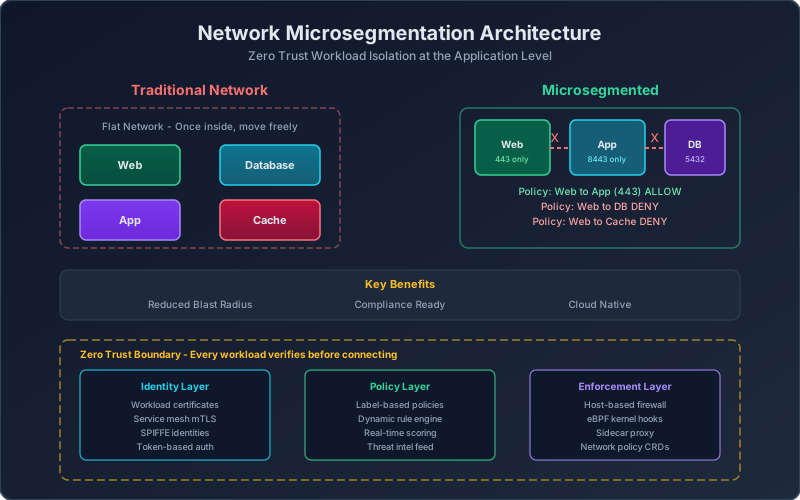
New Year, New Attack Surface: Why Q1 Is the Best Time to Start Microsegmentation
January is when security teams emerge from the holiday freeze to face a familiar beast: the CVE backlog. December typically sees reduced patching cycles, delayed change approvals, and skeleton crews. By the first week of January, the accumulated vulnerability queue can feel insurmountable.
But there is a structural approach that makes the Q1 cleanup not just manageable but genuinely effective — and it starts with microsegmentation.
Why Segmentation First
Every CVE in your backlog represents a potential entry point. But not all entry points are created equal. The difference between a catastrophic breach and a contained incident often comes down to lateral movement — can the attacker pivot from the initial foothold to your crown jewels?
Microsegmentation directly addresses this by enforcing least-privilege communication between workloads. Even if a vulnerability is exploited in a web-facing service, microsegmentation ensures that compromised workload can only reach its explicitly permitted dependencies. The blast radius is contained before the attacker can probe for privilege escalation.
For teams mapping out their Q1 security roadmap, the calculus is straightforward: patching closes known doors, but segmentation limits what an attacker can do even when a door is left open. That defense-in-depth principle is especially critical during the January catch-up period when not every CVE can be patched immediately.
Practical First Steps
Start with discovery. Deploy monitoring agents or enable flow logs across your infrastructure to map east-west traffic patterns. Most organizations running this exercise for the first time discover that 40-60% of inter-workload communication is unnecessary — orphaned connections from decommissioned services, overly permissive firewall rules, and undocumented dependencies.
Run the discovery phase for two weeks. Then define a “deny-all-default” policy for your most sensitive workloads — production databases, authentication services, PCI-scoped systems. Allow only the traffic your monitoring data proves is necessary.
For teams already managing web application security, integrating microsegmentation with your WAAP strategy amplifies both investments. The WAAP at waap-security.uk handles north-south threats at the application layer, while microsegmentation seals east-west movement inside your network. For AI-driven threat detection that enhances your Q1 security posture, aisecurities.uk provides continuous traffic analysis.
The Bottom Line
January is the right time to start microsegmentation because you have the organizational momentum of Q1 planning, and the CVE backlog gives you a concrete problem to solve. Don’t try to segment everything at once. Start with visibility, prove containment on one critical workload class, and expand from there.
Interested in a deeper dive? Check out these resources on Amazon:
- Zero Trust Networks: Building Secure Systems in Untrusted Networks
- The Practice of Network Security Monitoring
As an Amazon Associate I earn from qualifying purchases.