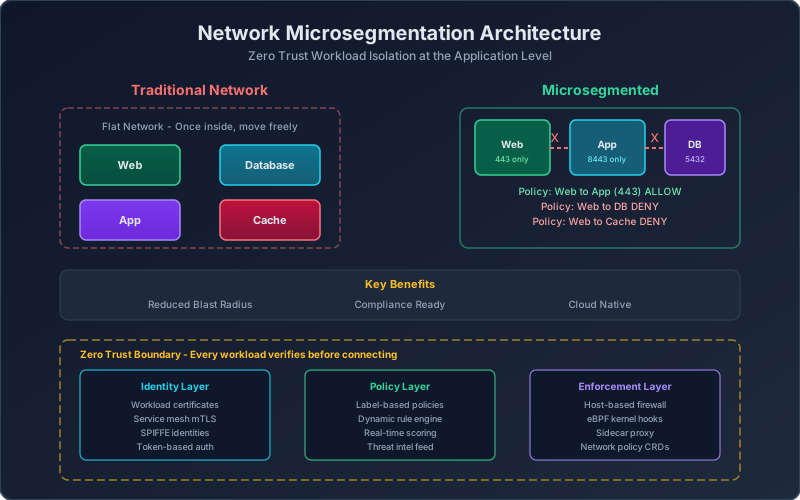
Tax Season Cybersecurity: Why Financial Institutions Need Microsegmentation
Tax season in the UK and US brings unique pressures to financial sector security teams. Transaction volumes spike, new temporary systems are deployed for tax processing, and the financial incentive for attackers to target payment systems and identity data peaks. April is when segmentation failures become visible.
Why Tax Season Exposes Segmentation Gaps
The financial sector operates under strict compliance frameworks — PCI DSS, SOC 2, PSD2, and the UK’s FCA regulations all mandate network segmentation. Yet every tax season, we see the same patterns of security degradation:
Temporary workloads bypass standard controls. Finance teams spin up additional processing capacity for the tax filing surge. These temporary workloads often run without proper security group assignment, firewall rules, or — critically — segmentation policies. They exist for six to eight weeks, then disappear. But during those weeks, they are a direct bridge into your financial processing environment.
Third-party integrations multiply. Tax preparation software, filing services, and payment gateways require new connections during tax season. Each integration is a potential east-west pathway from an external service into your internal systems.
Insider threat risk increases. Seasonal staff and contractors are brought on to handle volume. Their access is typically broader than necessary because “they need to get the work done.” Broad access in a flat network means broad blast radius.
Segmentation as Compliance
For PCI DSS compliance specifically, microsegmentation provides auditable controls that traditional firewall rules struggle to match:
- Identity-based scoping — the cardholder data environment is defined by workload identity, not by IP range. When an auditor asks “what workloads are in scope,” you provide a list of labeled workloads, not a spreadsheet of IP addresses.
- Continuous enforcement — if a workload outside the CDE tries to communicate with a CDE workload, the connection is blocked automatically, regardless of network topology changes.
- Audit-ready logging — every blocked connection, every policy change, and every identity verification is logged with timestamps and workload identifiers.
Practical Steps for Tax Season
Before the tax season peak, deploy these controls:
- Tag all tax-season workloads with a
Seasonal: Tax2026label - Define a default-deny policy for that tag — explicitly allow only the specific east-west connections they require
- Set the policy expiration date for May 31 so seasonal policies automatically decommission when tax season ends
For web-facing financial applications, ensure your WAAP configuration at waap-security.uk is updated for the seasonal traffic surge. For AI-driven security analytics that can detect anomalous traffic patterns during the tax season peak, aisecurities.uk provides real-time monitoring of your segmentation controls.
The Bottom Line
Tax season is a predictable high-risk period for financial sector security. Microsegmentation provides the controls to handle the seasonal chaos without sacrificing security posture — and it gives auditors the evidence they need to validate compliance.
Want to go deeper? Check out these resources on Amazon:
- PCI Compliance: Understand and Implement Effective PCI Data Security Standard Compliance
- Financial Services Security
As an Amazon Associate I earn from qualifying purchases.