What Is Microsegmentation? A Beginner's Guide to Zero Trust Network Segmentation
If your network is flat, one breach can reach everything. Microsegmentation is the answer — it breaks your network into isolated zones so a compromise in one area can’t spread to another. This guide explains what microsegmentation is, how it works, and why it’s the foundation of any real zero trust architecture.
What Is Microsegmentation?
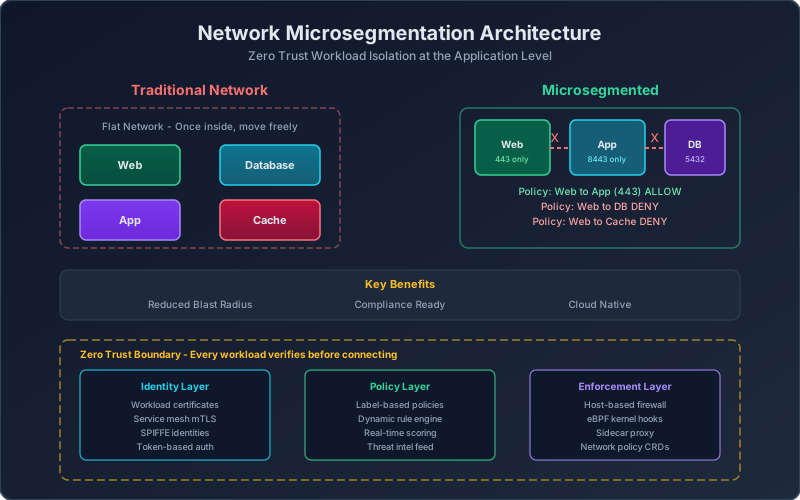
Microsegmentation is a network security technique that divides a data center or cloud environment into isolated logical zones, right down to the individual workload level. Instead of placing a firewall at the network perimeter and trusting everything inside, microsegmentation enforces security policies between every workload — every VM, container, server, and function.
Think of it like an apartment building. Traditional network security locks the front door (perimeter firewall). Microsegmentation adds a lock on every apartment door, plus a rule about who can visit which apartment. Even if someone picks the front door lock, they can’t walk into every unit.
Microsegmentation Definition
The formal definition: microsegmentation is the practice of applying granular, workload-level security policies that control east-west traffic within a network. Unlike traditional network segmentation that uses VLANs and subnets at the data center level, microsegmentation operates at the hypervisor, container orchestrator, or cloud networking layer — enabling per-workload policy enforcement regardless of IP address, physical location, or network topology.
How Microsegmentation Works
Microsegmentation works through three mechanisms:
Identity-based policies. Each workload gets an identity tag — for example, “production-database,” “frontend-web-tier,” or “batch-processing-job.” Policies define which identities can communicate: “production-database may accept connections from frontend-web-tier on TCP 3306; nothing else.”
Kernel-level enforcement. Instead of routing traffic through a central firewall (which becomes a bottleneck), microsegmentation agents run on each host’s operating system kernel. A hypervisor-level or eBPF-based firewall enforces policies at the network interface, intercepting every packet before it reaches the workload.
Centralized policy management. All policies are defined once in a central controller and distributed to every enforcement point. This means you can write “block all east-west traffic except explicitly allowed flows” as a global rule and override it only where needed — no per-firewall CLI sessions.
Microsegmentation vs. Traditional Network Segmentation
| Aspect | Traditional Segmentation | Microsegmentation |
|---|---|---|
| Boundary | VLAN/subnet level | Per-workload (VM, container, pod) |
| Policy changes | Days to weeks (firewall tickets) | Minutes (CI/CD policy pipeline) |
| Traffic scope | North-south (in/out of segment) | East-west (between workloads) |
| Attack containment | Within one subnet | Within one workload |
| Cloud support | Poor (VLANs don’t span cloud VPCs) | Native (tags follow workloads) |
| Operational model | Static, manual | Dynamic, automated |
Traditional segmentation puts workloads in the same broadcast domain and assumes everything inside the VLAN is trusted. Microsegmentation assumes zero trust between workloads — because in a modern data center, an attacker who reaches one container has immediate lateral access to everything on the same host or subnet.
Microsegmentation in Networking
In networking terms, microsegmentation moves policy enforcement from the network perimeter to the workload itself. This is a fundamental shift:
- Traditional model: Firewall at edge → trusted internal network → workloads
- Microsegmentation model: Each workload has its own firewall → every packet verified → zero trust
This is why microsegmentation is the enforcement mechanism that makes zero trust real. Without it, a zero trust architecture is just identity and access management — important, but insufficient when an attacker is already inside the network.
What Does Microsegmentation Do in a Zero Trust Architecture?
In a zero trust architecture, microsegmentation provides:
Lateral movement prevention. The most common attack path involves compromising one workload, then pivoting laterally to find valuable data. Microsegmentation blocks lateral movement by default — each workload can only reach the specific services it needs.
Compliance enforcement. Regulations like PCI DSS, HIPAA, and SOC 2 require network segmentation between environments and data classifications. Microsegmentation provides auditable, workload-level isolation that satisfies compliance requirements without rigid VLAN boundaries.
Visibility into east-west traffic. Deploying microsegmentation in monitor-only mode reveals actual traffic patterns. Most organizations discover that their workloads communicate far more broadly than anyone expected. This visibility alone justifies the deployment.
Consistent policy across hybrid cloud. Microsegmentation policies follow workloads whether they run on-premises, in AWS, Azure, or GCP. The same “database tier accepts from app tier” rule works everywhere.
Microsegmentation Meaning for Cloud Security
For cloud environments, microsegmentation solves a problem traditional security tools can’t: cloud VPCs are flat by default. A container in your Kubernetes cluster can reach any other container unless explicitly blocked. Cloud security groups help, but they’re tied to IP addresses and availability zones — not workload identities.
Microsegmentation adds identity-based controls on top of your cloud provider’s native security. It answers the question: “Should this specific pod in namespace ‘checkout’ be talking to that specific database in namespace ‘inventory’?” — and blocks it if the answer is no.
Getting Started with Microsegmentation
For beginners, the practical path is:
- Enable monitoring mode first. Your microsegmentation vendor’s agent can run in observe-only mode. Let it learn traffic patterns for 2-4 weeks before writing any deny rules.
- Tag everything. Every workload needs identity tags: environment (prod/staging/dev), role (web/app/db), and sensitivity (public/internal/pci).
- Define essential flows. Start with the three most critical data flows in your environment. Write allow rules for those. Block everything else to those workloads.
- Expand incrementally. Add one workload category per week. This keeps the blast radius of any misconfiguration small.
- Automate policy deployment. Once you have a stable policy set, move to CI/CD-driven policy management so changes deploy through git pull requests rather than manual firewall tickets.
For protecting the application layer at the perimeter alongside your internal segmentation, WAAP Security covers north-south traffic protection. For AI-driven traffic anomaly detection that flags unusual lateral movement patterns in real-time, AI Securities provides continuous monitoring.
Common Questions About Microsegmentation
What’s the difference between microsegmentation and network segmentation? Network segmentation divides networks at the subnet or VLAN level. Microsegmentation divides at the individual workload level — every VM, container, or server gets its own security boundary.
Is microsegmentation the same as zero trust? No. Zero trust is the architecture; microsegmentation is the enforcement mechanism. You can have zero trust policies without microsegmentation, but you can’t enforce them reliably without workload-level isolation.
Do I need microsegmentation in the cloud? Yes. Cloud VPCs are flat networks by default — any workload can reach any other workload on the same network. Microsegmentation adds the workload-level controls that cloud providers’ native security groups don’t offer.
How much does microsegmentation add to latency? Properly implemented, less than 1ms per packet. Kernel-level enforcement (eBPF, hypervisor-based) adds negligible overhead compared to the security benefit.
Want to go deeper? Check out these resources on Amazon:
- Zero Trust Networks: Building Secure Systems in Untrusted Networks
- Network Security Through Data Analysis
As an Amazon Associate I earn from qualifying purchases.